
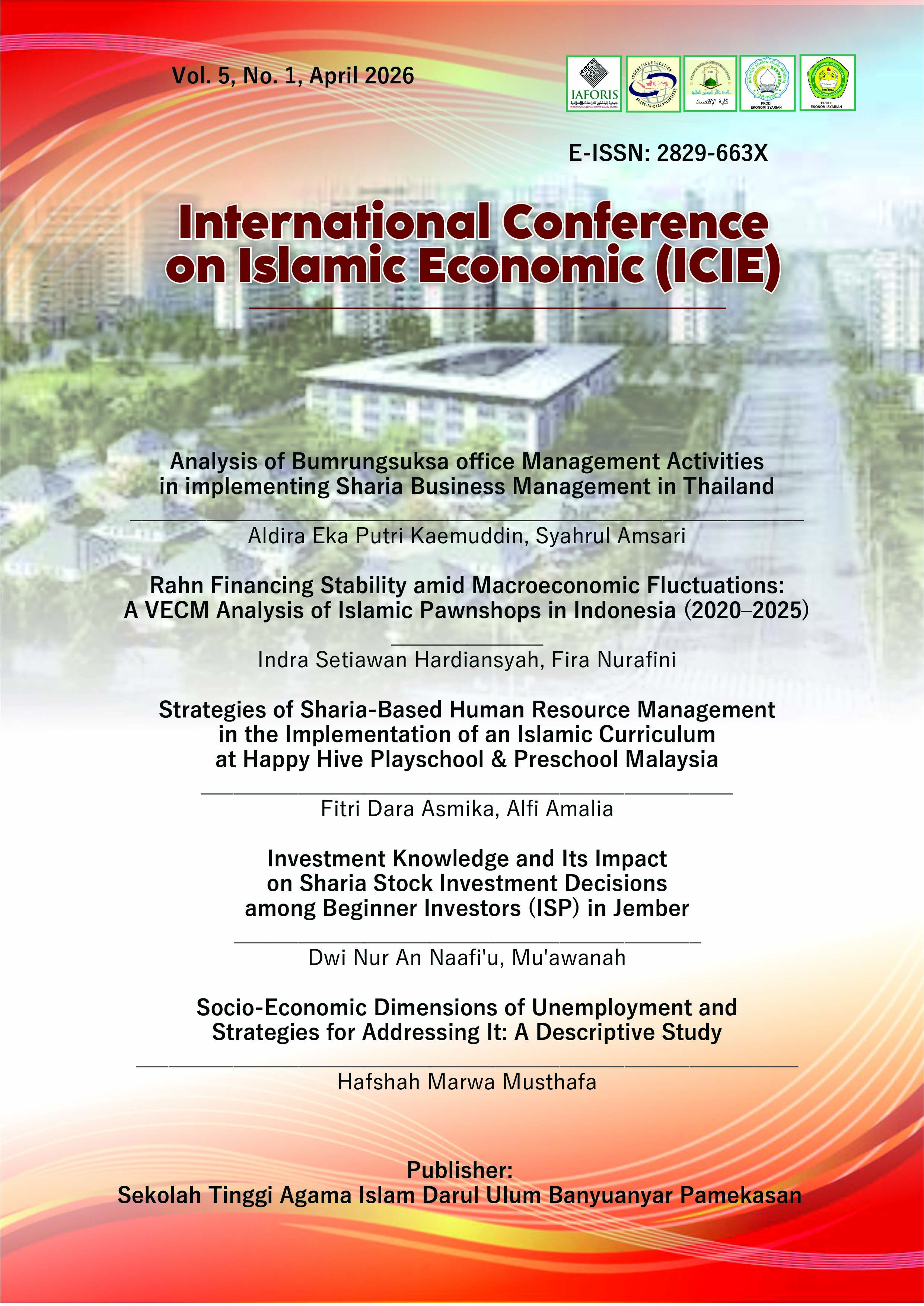
Strategies of Sharia-Based Human Resource Management in the Implementation of an Islamic Curriculum at Happy Hive Playschool & Preschool Malaysia
DOI:
https://doi.org/10.58223/icie.v5i1.467Keywords:
Sharia-Based Human Resources, Early Childhood Education, Islamic CurriculumAbstract
The implementation of an Islamic curriculum in early childhood education institutions frequently encounters challenges related to inconsistent instructional practices caused by variations in teachers’ competencies, diverse educational backgrounds, and the suboptimal integration of Sharia values within the human resource management system. This condition reflects a gap between the design of the Islamic curriculum and its practical implementation in classroom settings. This study aims to analyze Sharia-based human resource management strategies, describe the implementation of the Islamic curriculum, and identify the role of HR management in supporting the consistency of curriculum implementation at Happy Hive Playschool & Preschool Malaysia. The study employed a descriptive qualitative approach with a case study design. Data were collected through observation, in-depth interviews, and documentation, and were analyzed interactively through data reduction, data display, and conclusion drawing. Triangulation techniques were applied to ensure data validity. The findings reveal that Sharia-based HR management strategies are implemented through character- and competency-based recruitment, continuous training and mentoring, and performance evaluation grounded in the principles of amanah (trustworthiness), ‘adl (justice), and ihsan (excellence). The Islamic curriculum is implemented through play-based learning, habituation of worship practices, and teachers’ role modeling. However, differences in teachers’ pedagogical and spiritual readiness continue to influence the equity of learning outcomes. This study affirms that the success of the Islamic curriculum is strongly determined by systematic and sustainable HR management integrated with the enhancement of teachers’ professional and spiritual competencies.
References
Amalia, R. (2022). The role of Islamic education teacher to build learners’ character at MTs Assalafiyah Tegal City. ATTARBIYAH: Journal of Islamic Culture and Education, 7(1), 81–95. https://doi.org/10.18326/attarbiyah.v7i1.81-95
Amiruddin, Qorib, M., & Zailani, Z. (2021). A study of the role of Islamic spirituality in happiness of Muslim citizens. HTS Teologiese Studies / Theological Studies, 77(4). https://doi.org/10.4102/hts.v77i4.6655
Ardiansyah, Jailani, Ms., Negeri, S., Provinsi Jambi, B., & Sulthan Thaha Saifuddin Jambi, U. (2023). Teknik Pengumpulan Data Dan Instrumen Penelitian Ilmiah. http://ejournal.yayasanpendidikandzurriyatulquran.id/index.php/ihsan
Ariyanto. (2023). MANAJEMEN SUMBER DAYA MANUSIA DI LEMBAGA PENDIDIKAN ISLAM: TANTANGAN DAN SOLUSI. In SCHOLASTICA: Jurnal Pendidikan dan Kebudayaan (Vol. 5).
Auwal Gano, A., Abdullahi, N., Lawan Adam, Z., & Setyawan, C. E. (2024). Integrating Islamic principles into human resource management: Advancing organizational success through Islamic education and ethical practices. Tadibia Islamika, 4(2), 62–74. https://doi.org/10.28918/tadibia.v4i2.9125
Ayyat, S. J., Md. Faruk Abdullah, & Abdul Halim, B. (2020). Conceptualising Islamic Human Resource Management Principles in the Context of Palestine. The Journal of Management Theory and Practice (JMTP), 1(2), 9–15. https://doi.org/10.37231/jmtp.2020.1.2.21
Aziz, M., Walimsyah Sitorus, M., & Al-Ittihadiyah Labuhanbatu Utara, S. (2025). Islamic Education Curriculum for Early Childhood in the Perspective of the Qur’an (Vol. 6, Number 2). Online. https://creativecommons.org/licenses/by-sa/4.0/
Basit, A., Ahmad, A., Azhari, D. S., Ingriza, R., & Qurba, A. (2024). Fundamental Human Resource Management Concepts for Islamic Educational Institutions: Fostering Character and Religious Values through Strategic Workforce Development. Abjadia : International Journal of Education, 9(3), 737–744. https://doi.org/10.18860/abj.v9i3.29828
Eka, Asiah, S. N., & Laili, L. M. (2022). Strategi dan Hambatan Manajemen Pengelolaan Lembaga Pendidikan Anak Usia Dini. Jurnal Manajemen Dan Pendidikan Islam, 90–91.
Febriani, N. N., Hidayatulla, M. R., & Thobroni, A. Y. (2025). Kurikulum Pendidikan Islam Sebagai Pedoman Pembelajaran Dalam Membentuk Karakter Religius Perspektif Al-Qur’an dan Hadits. Jurnal IHSAN : Jurnal Pendidikan Islam, 3(3), 683–692. https://doi.org/10.61104/ihsan.v3i3.1420
Ghulamkhan, A. (2025). Core Principles of Islamic Human Resource Management.
Hamidin, M., Norfaezah, Nurhajariah binti Md Isa, S., binti Abdul Rahman, A., & Hamdi, I. (2016). PENDIDIKAN AWAL KANAK-KANAK (PAKK) DI MALAYSIA: KAJIAN LITERATUR.
Hayati, I. (2016). Implementasi Model Pembelajaran Two Stay Two Stray (TSTS) Untuk Meningkatkan Aspek Kognitif dan Aspek Afektif Mahasiswa Pada Mata Kuliah Akuntansi Keuangan Semester III Kelas A Pagi Program Studi Perbankan Syariah Universitas Muhammadiyah Sumatera Utara Tahun Akademik 2015/ 2016.
Kasmir, Kuswanto, Lapadang, L., Mansur, Sari Siregar, M., & Mashar, A. (2025). MANAJEMEN SUMBER DAYA MANUSIA PADA LEMBAGA PENDIDIKAN ISLAM. https://journal.an-nur.ac.id/index.php/unisanjournal
Khaira, K., & Sesmiarni, Z. (2025). Analysis Of Human Resource Management Strategies In Islamic Education. Jawda: Journal Of Islamic Education Management, 6, 82–94. https://iournal.walisongo.ac.id/index.php/jawda
Kurniawati, D., Madrasah, P., Mts, T., Kantor, M. A., Agama, K., & Timur, L. (2018). MANAJEMEN SUMBERDAYA MANUSIA DALAM PERSPEKTIF ISLAM DAN ELEVANSINYA DENGAN MANAJEMEN MODERN. https://ejournal.radenintan.ac.id/index.php/ijtimaiyya/index
Lenes, R., McClelland, M. M., ten Braak, D., Idsøe, T., & Størksen, I. (2020). Direct and indirect pathways from children’s early self-regulation to academic achievement in fifth grade in Norway. Early Childhood Research Quarterly, 53, 612–624. https://doi.org/10.1016/j.ecresq.2020.07.005
Maulidina, J., Aini, N., & Wahyuni, S. (2020). Islamic EduKids: Jurnal Pendidikan Anak Usia Dini Pengembangan Kurikulum Pembelajaran AUD Berbasis Tauhid. 02(01).
Mujib, M. F., Ma’shum, F. A., & Nursikin, M. (2025). The Strategic Role of Curriculum in the Transformation of Islamic Education. Al-Mudarris (Jurnal Ilmiah Pendidikan Islam), 8(1), 51–68. https://doi.org/10.23971/mdr.v8i1.9794
Nirwana, E. S., Ramadhani, A. P., & Silvia. (2025). PROBLEMATIKA PENDIDIKAN ANAK USIA DINI DI INDONESIA: HAMBATAN. 5(1), 2025. https://jurnalp4i.com/index.php/manajerial
Pasaribu, M. (2022). Pendidikan Karakter Menurut Al-Quran Surat As-Syams ayat 8-10 Munawir Pasaribu Fakultas Agama Islam jurusan Pendidikan Agama Islam UMSU.
Qomaruddin, Q., & Sa’diyah, H. (2024). Kajian Teoritis tentang Teknik Analisis Data dalam Penelitian Kualitatif: Perspektif Spradley, Miles dan Huberman. Journal of Management, Accounting, and Administration, 1(2), 77–84. https://doi.org/10.52620/jomaa.v1i2.93
Rahman, H. (2025). Human Resource Management In Optimizing The Performance Of Teaching Staff In Integrated Islamic Elementary Schools. 5(1), 27–34. https://doi.org/10.24042/te1nnv86
Ramli, M. A. (2022). Early Childhood Education in Islamic Perspective. Bulletin of Early Childhood, 1. https://attractivejournal.com/index.php/bec
Zulfa, M. S. (2023). Hakikat Pengembangan Kurikulum Pendidikan Islam : Tujuan, Materi, Metode, Dan Evaluasi.
Barokah, F. U., & Gunawan, A. (2023). Global : Jurnal Lentera BITEP Strategi Rekrutmen dan Seleksi yang Efektif untuk Meningkatkan Kualitas Tenaga Kerja. https://lenteranusa.id/
Wahyuni, I. (2023). MANAJEMEN SUMBER DAYA MANUSIA SEBAGAI PILAR STRATEGIS DALAM PENGELOLAAN LEMBAGA PENDIDIKAN. Jurnal Manajemen Pendidikan. https://doi.org/10.55352/mudir
Yusuf, E., & Nata, A. (2023). Evaluasi dan Pengembangan Kurikulum Pendidikan Islam. Edukasi Islami: Jurnal Pendidikan Islam, 12(01). https://doi.org/10.30868/ei.v12i01.2868
Zaini, A. W. (2023). Beyond the Curriculum: Exploring the Influence of Islamic Values and Teacher Role Models on Student Character Formation. AFKARINA: Jurnal Pendidikan Agama Islam, 9(1), 23–34. https://doi.org/10.33650/afkarina.v8i2.9389
Zulkarnain, L. (2023). Manajemen Sumber Daya Manusia dalam Pendidikan Islam. INTELEKTIUM, 3(2), 409–421. https://doi.org/10.37010/int.v3i2.1114
Downloads
Published
Issue
Section
License
Copyright (c) 2026 Fitri Dara Asmika, Alfi Amalia

This work is licensed under a Creative Commons Attribution 4.0 International License.
International Conference on Islamic Economic diterbitkan berdasarkan ketentuan Creative Commons Attribution 4.0 International License / CC BY 4.0 Lisensi ini mengizinkan setiap orang untuk menyalin dan menyebarluaskan kembali materi ini dalam bentuk atau format apapun, menggubah, mengubah, dan membuat turunan dari materi ini untuk kepentingan apapun, termasuk kepentingan komersial, selama mereka mencantumkan kredit kepada Penulis atas ciptaan asli.


