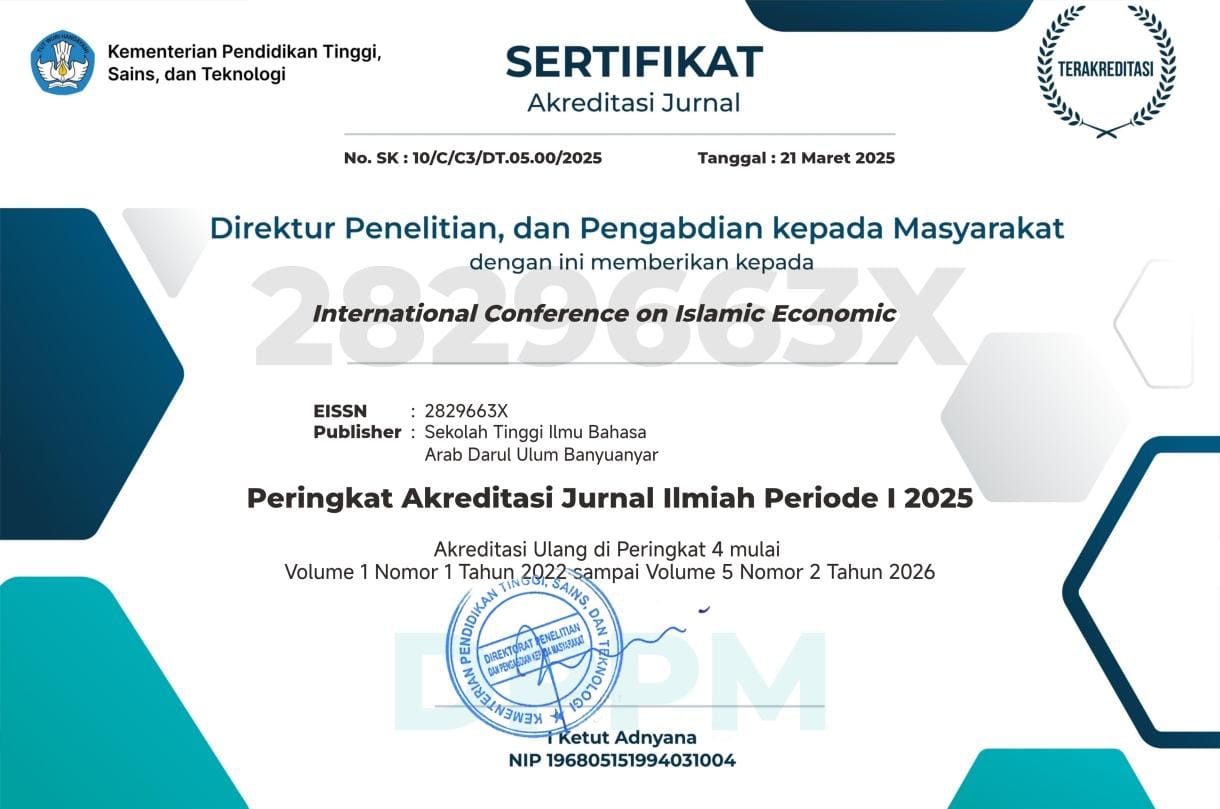
International Conference on Islamic Economic is committed to maintaining the highest standards of research integrity, academic honesty, and publication ethics. The journal takes allegations of research misconduct seriously and is committed to handling all reports fairly, objectively, confidentially, and transparently.
Research misconduct may include, but is not limited to, plagiarism, self-plagiarism, data fabrication, data falsification, inappropriate authorship, duplicate publication, undisclosed conflicts of interest, manipulation of citations, and other practices that violate accepted standards of responsible research and scholarly publication.
Authors, reviewers, editors, readers, and other parties who have credible concerns regarding potential research or publication misconduct in an article submitted to or published by the journal may report their concerns to the editorial team. Reports should include relevant evidence and sufficient information to enable a preliminary assessment.
Upon receiving an allegation, the editorial team will conduct an initial assessment to determine whether the concern falls within the journal's responsibility and whether sufficient information is available for further examination. When necessary, the editor may request additional information from the complainant, the authors, or relevant institutions.
The journal will assess allegations impartially and will provide the individuals concerned with an appropriate opportunity to respond. Where necessary, the editorial team may consult independent experts, reviewers, or the relevant author's institution to support a fair and evidence-based investigation.
All allegations will be handled with appropriate confidentiality to protect the rights and reputations of the parties involved. The journal will avoid premature conclusions and will not regard an allegation as proof of misconduct. Information will be shared only with parties who need it for the assessment or investigation, subject to applicable ethical and legal requirements.
If research or publication misconduct is established, the journal will take appropriate action proportionate to the nature and severity of the violation. Such action may include:
Requesting corrections or clarification from the authors.
Rejecting a manuscript that has not yet been published.
Publishing a correction, expression of concern, or retraction for a published article, where appropriate.
Notifying the relevant institution or other responsible body when warranted.
Restricting future submissions in cases of serious or repeated misconduct, in accordance with the journal's policies.
Any editorial action will be based on the available evidence and the outcome of the assessment or investigation.
International Conference on Islamic Economic seeks to protect the credibility of the scholarly record and promote responsible research practices. The journal encourages authors, reviewers, editors, and readers to uphold honesty, transparency, accountability, and respect for ethical standards in all stages of scholarly communication.
All allegations will be handled in accordance with the journal's publication ethics policies and recognized principles of responsible scholarly publishing.
ICIE is an academic journal managed and published by Sekolah Tinggi Agama Islam Darul Ulum Banyuanyar (STAI DUBA). The journal serves as a scholarly platform for the dissemination of research and academic discussions in Arabic language and literature, Islamic studies, and related disciplines.
The journal's management is organized through an editorial structure responsible for overseeing the publication process, maintaining academic standards, and ensuring compliance with publication ethics. The editorial team includes an editor-in-chief, editors, and other editorial personnel whose responsibilities encompass manuscript screening, coordination of the peer-review process, editorial decision-making, and preparation of accepted manuscripts for publication.
The journal operates under the institutional responsibility of STAI DUBA, while editorial decisions are guided by scholarly merit, originality, relevance to the journal's scope, and adherence to ethical publishing practices. The editorial team is expected to exercise professional independence in evaluating submissions and to manage potential conflicts of interest transparently.
Information concerning the journal's publisher, editorial board, institutional affiliation, and management structure is made available through the journal's official website. The journal is committed to transparent management, responsible editorial governance, and the continuous improvement of its publication quality.
ICIE is committed to maintaining transparency, integrity, and objectivity throughout the publication process. All authors, editors, and reviewers are required to disclose any potential conflicts of interest that could influence, or be perceived to influence, the preparation, evaluation, and publication of a manuscript.
A conflict of interest may arise from financial, professional, institutional, personal, or other relationships that could affect the impartiality of research or editorial decisions.
Authors must disclose any relevant conflicts of interest when submitting their manuscripts. If no conflicts of interest exist, authors should explicitly state that there are no conflicts of interest to declare.
Editors and reviewers must also disclose any potential conflicts of interest and recuse themselves from the editorial or peer-review process when such conflicts could compromise their impartiality. The editorial team will take appropriate measures to ensure that all manuscripts are evaluated fairly, objectively, and independently.
All declared conflicts of interest will be handled confidentially and in accordance with the journal's publication ethics policies. The journal is committed to ensuring that editorial decisions are based on the scholarly quality, originality, relevance, and academic contribution of submitted manuscripts, rather than on personal, financial, or institutional interests.