Unpacking Structural Poverty through a Sustainable Economic Lens: A Qualitative Literature Review
DOI:
https://doi.org/10.58223/icie.v4i1.403Keywords:
Structural Poverty, Sustainable Economics, Literature Review, Social JusticeAbstract
Structural poverty represents a persistent form of deprivation that arises from systemic social and economic inequalities, yet it has not been sufficiently addressed within the framework of sustainable development. This gap is critical because sustainable development goals inherently emphasize inclusivity, justice, and long-term equity. The purpose of this study is to analyze how structural poverty is conceptualized and interpreted in relation to sustainable economics, as well as to explore its implications for achieving sustainability-oriented policies and practices. This research employs a qualitative literature review, systematically analyzing scholarly publications from the last ten years. Thematic analysis was applied to identify dominant themes, theoretical orientations, and empirical findings concerning the nexus of poverty and sustainability. The results show that structural socio-economic inequalities remain a major barrier to fulfilling sustainable development goals, particularly those related to social and economic justice. Moreover, the study provides a conceptual mapping that highlights how interdisciplinary approaches—from economics, sociology, and environmental studies—offer valuable insights into addressing the systemic roots of poverty. The contribution of this study lies in deepening theoretical understanding while simultaneously offering practical relevance. It underscores the urgency of integrating structural poverty into sustainability discourse and suggests that future policy must address systemic inequalities to promote more equitable and sustainable development.
References
Andina, W., & Wahyudi, A. (n.d.). Upaya Pengentasan Kemiskinan Dalam Mewujudkan Kesejahteraan Sosial Islami.
Annur, R. A. (2013). FAKTOR-FAKTOR YANG MEMPENGARUHI KEMISKINAN DI KECAMATAN JEKULO DAN MEJOBO KABUPATEN KUDUS TAHUN 2013.
Fadli, M. R. (2021). Memahami desain metode penelitian kualitatif. 21(1).
Fiantika, F. R., Wasil, M., Jumiyati, S., Honesti, L., Wahyuni, S., & Mouw, E. (n.d.). METODOLOGI PENELITIAN KUALITATIF.
Fithri, N., & Kaluge, D. (2017). ANALISIS PENGARUH PENGELUARAN PEMERINTAH SEKTOR PENDIDIKAN DAN KESEHATAN TERHADAP KEMISKINAN DI JAWA TIMUR. Jurnal Ekonomi Pembangunan, 15(2), 129. https://doi.org/10.22219/jep.v15i2.5360
Haris Maiza Putra, Hisam Ahyani, Dede Abdurohman, Naeli Mutmainah, & Memet Slamet. (2022). Relevansi Kesejahteraan Ekonomi Masyarakat Melalui Pengalokasian dan Pendistribusian Pendapatan Negara di Indonesia Perspektif Ekonomi Islam. Syarikat: Jurnal Rumpun Ekonomi Syariah, 5(1), 196–211. https://doi.org/10.25299/syarikat.2022.vol5(1).9404
Nizar, C., Hamzah, A., & Syahnur, S. (n.d.). PENGARUH INVESTASI DAN TENAGA KERJA TERHADAP PERTUMBUHAN EKONOMI SERTA HUBUNGANNYA TERHADAP TINGKAT KEMISKINAN DI INDONESIA.
nurjanah. (2021). Jurnal Mahasiswa Volume 1, Nopember 2021. 1.
Prasanti, D. (2018). Penggunaan Media Komunikasi Bagi Remaja Perempuan Dalam Pencarian Informasi Kesehatan. LONTAR: Jurnal Ilmu Komunikasi, 6(1). https://doi.org/10.30656/lontar.v6i1.645
Silooy, M. (2017). ANALISIS FAKTOR-FAKTOR YANG MEMPENGARUHI TINGKAT KEMISKINAN ABSOLUT MASYARAKAT PESISIR ( NELAYAN ) DI DESA SEILALE KECAMATAN NUSANIWE. Jurnal Cita Ekonomika, 11(1), 79–84. https://doi.org/10.51125/citaekonomika.v11i1.2634
Solikatun, S., Masruroh, Y., & Zuber, A. (2018). KEMISKINAN DALAM PEMBANGUNAN. Jurnal Analisa Sosiologi, 3(1). https://doi.org/10.20961/jas.v3i1.17450
Suryawati, C. (n.d.). MEMAHAMI KEMISKINAN SECARA MULTIDIMENSIONAL.
Tobing, D. H., Herdiyanto, Y. K., Astiti, D. P., Rustika, I. M., Indrawati, K. R., Vembriati, N., Widiasavitri, P. N., & Budisetyani, P. W. (n.d.). METODE PENELITIAN KUALITATIF.
Waruwu, M. (2023). Pendekatan Penelitian Pendidikan: Metode Penelitian Kualitatif, Metode Penelitian Kuantitatif dan Metode Penelitian Kombinasi. 7.
Zahrawati, F. (2020). Pembebasan Jerat Feminisasi Kemiskinan. AL MA’ARIEF : Jurnal Pendidikan Sosial dan Budaya, 2(1), 9–16. https://doi.org/10.35905/almaarief.v2i1.1327
Zhao, X., Wang, Y., Li, J., & Chen, H. (2025). Digital village construction and rural poverty vulnerability: Evidence from China. Scientific Reports, 15(1), 91928. https://doi.org/10.1038/s41598-025-91928-7
Organisation for Economic Co-operation and Development (OECD). (2024). Breaking the vicious circles of informal employment and low-paying work. OECD Publishing. https://www.oecd.org/content/dam/oecd/en/publications/reports/2024/01/breaking-the-vicious-circles-of-informal-employment-and-low-paying-work_040b6f24/f95c5a74-en.pdf
Bettencourt, L., & Marchio, N. (2023). Informal settlements and infrastructure inequality in Africa: A block-level analysis. arXiv preprint arXiv:2307.16328. https://arxiv.org/abs/2307.16328
Rodgers, G. (2025). Informality and inequality: Structural features of labour in the informal economy. Industrial Law Journal. Advance online publication. https://doi.org/10.1093/indlaw/dwae057
Times of India. (2025, February 16). Rationalisation fixes shortage of teachers in remote areas. The Times of India. https://timesofindia.indiatimes.com/city/raipur/rationalisation-fixes-shortage-of-teachers-in-remote-areas/articleshow/121761988.cms

Downloads
Published
Issue
Section
License
Copyright (c) 2025 Muhamad Fardan, Hariyono

This work is licensed under a Creative Commons Attribution 4.0 International License.
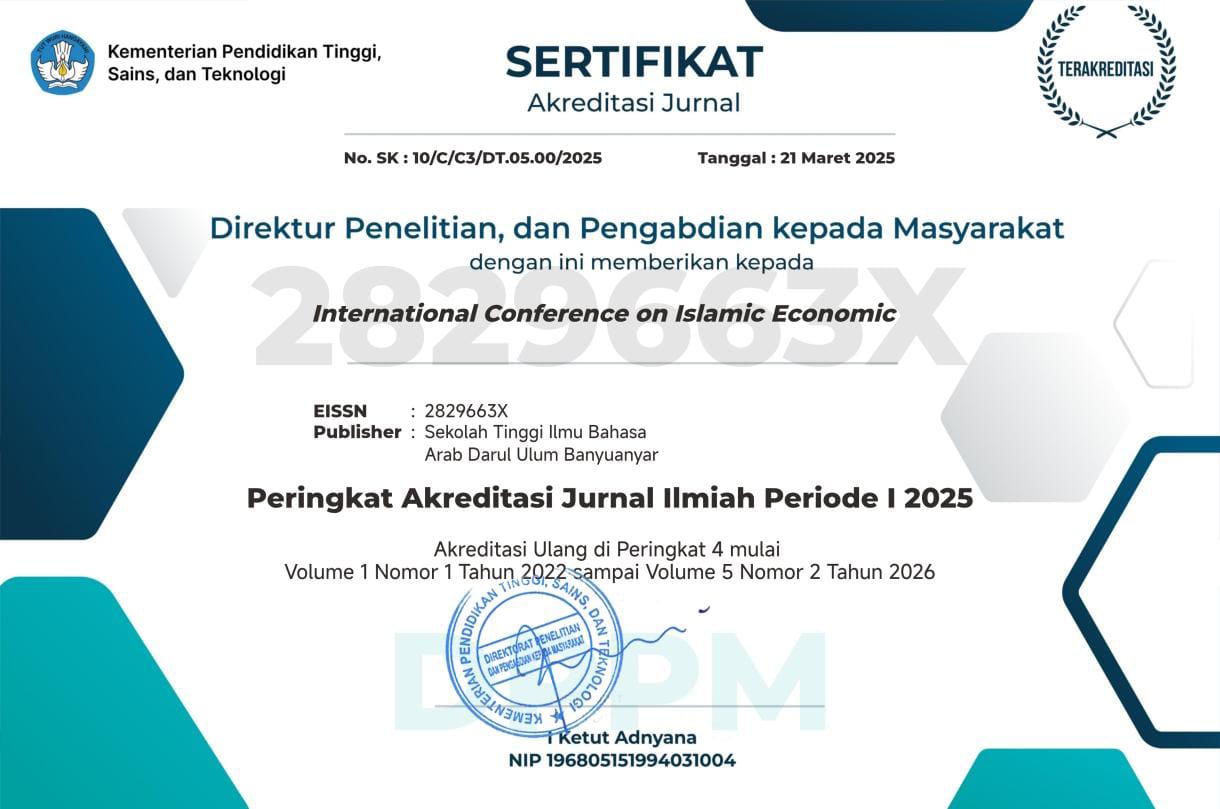
International Conference on Islamic Economic diterbitkan berdasarkan ketentuan Creative Commons Attribution 4.0 International License / CC BY 4.0 Lisensi ini mengizinkan setiap orang untuk menyalin dan menyebarluaskan kembali materi ini dalam bentuk atau format apapun, menggubah, mengubah, dan membuat turunan dari materi ini untuk kepentingan apapun, termasuk kepentingan komersial, selama mereka mencantumkan kredit kepada Penulis atas ciptaan asli.